4 LinkedIn Mistakes That Could Be Stopping You From Getting Clients
Aug 26, 2026
You're posting on LinkedIn.
You've updated your profile.
You comment on other people's posts.
You might even be getting views, likes and new connections.
But chances are, there's one rather important thing missing: Clients.
If that sounds familiar, it's very easy to conclude that LinkedIn simply doesn't work for you. But before you abandon it, I'd look at how you're using LinkedIn. Because being active and having a strategy are two very different things.
Over the years, I've worked with hundreds of coaches and service providers, and I've seen the same LinkedIn mistakes come up again and again. The frustrating part is that you can be doing a lot of things "right" and still make one of these mistakes.
So, rather than simply telling you what they are, let's look at how to recognize each one and, more importantly, what to do instead.
LinkedIn Mistake #1: Assuming Your Niche Isn't Right for LinkedIn
I've heard variations of this one many times:
"LinkedIn doesn't work for my niche."
"My clients aren't really on LinkedIn."
"LinkedIn is too corporate for what I do."
And I understand why people think that.
If you're a leadership consultant selling to HR departments, LinkedIn seems like an obvious choice. If you're a relationship coach, health practitioner, yoga teacher or someone selling directly to individuals, perhaps less so. But there's a mistake hidden in the question.
You're asking:
"Do people go to LinkedIn specifically looking for someone like me?"
A better question is:
"Are the people I want to reach spending time on LinkedIn?"
Those are two very different things.
Someone doesn't stop being interested in their health, relationships, finances, career, confidence or personal development when they log into LinkedIn. They're still a human being.
And if you're selling B2B services, LinkedIn can play another important role.
Perhaps you meet someone at a conference.
They hear you speak on a podcast.
Someone recommends you.
What's one of the first things they're likely to do?
Look you up.
Your LinkedIn presence then becomes part of how they decide whether they want to know more.
How to tell if LinkedIn makes sense for your business
Instead of guessing, do a little research. Search LinkedIn for the types of people or companies you want to work with.
Look at:
- Job titles
- Industries
- Companies
- Professional communities
- People following relevant creators
- Conversations happening around the problems you solve
Then ask yourself:
Can I identify enough of the people I want to reach here to justify spending time on LinkedIn?
If yes, the problem probably isn't your niche, but it may be your strategy.
What to do instead
Don't create generic "value content" and hope the right people magically find it. Create content around the actual questions, problems, decisions and ambitions your ideal clients have. Then participate in the places where those people are already having conversations. For example, if you're a leadership coach, don't just post:
"5 ways to become a better leader."
Talk about something more specific:
"What to do when you've been promoted to lead people who were your peers six months ago."
Now I know who you're talking to. Specificity gives people a reason to stop scrolling.
LinkedIn Mistake #2: Your Positioning Is Too Broad
This one often hides behind perfectly professional-looking profiles.
You visit someone's profile and see something like:
Helping people reach their potential | Coach | Speaker | Consultant
It sounds nice.
I just have absolutely no idea whether I need you, and that's the problem.
If someone has to investigate your entire profile to understand what you actually do, you're making them work far too hard.
And people on the internet are not famous for their patience.
Try the five-second test
Open your LinkedIn profile and imagine you've never seen it before. Look at your headline and top section for five seconds. Then answer:
Who is this person for?
What do they help with?
Why might I want to keep reading?
If those answers aren't reasonably clear, your positioning needs work.
Being specific doesn't mean you can only do one thing forever. This is where people often panic.
"But I can help lots of different people."
I'm sure you can.
That doesn't mean you need to advertise everything you're capable of doing at the same time.
Imagine walking past two restaurants.
One says:
Food for everyone. We cook everything.
The other says:
Fresh handmade Italian pasta.
Which one creates a clearer expectation?
Specificity makes it easier for someone to recognize that they're in the right place.
What to do instead
Try completing this sentence:
I help [specific person] achieve [specific result] by helping them [specific solution].
It doesn't have to become your permanent tagline. It's an exercise in clarity. Then look at your:
- LinkedIn headline
- Banner
- About section
- Featured section
- Experience section
- Recent content
Do they all tell roughly the same story?
Because if your headline says one thing, your banner says another and your last six posts cover six unrelated topics, your audience has to piece the puzzle together themselves. Your job is to make the puzzle ridiculously easy.
LinkedIn Mistake #3: Putting Too Much Energy Into Your Business Page
I recently wrote an entire article about LinkedIn business pages because this causes so much confusion.
Should you have one?
Yes, I think there's a good reason to create one.
Should a coach, consultant or service provider spend most of their LinkedIn time trying to grow it?
Probably not.
There's an important distinction between having a LinkedIn business page and making it the centre of your LinkedIn strategy.
Your business page can support your presence. It gives your company an official home on LinkedIn, allows you to connect your business to the Experience section of your profile, and gives people another trust signal when they're researching you. But if you're the face of your business, your personal LinkedIn profile is where I'd put most of your attention.
Why?
Because you're building relationships between people.
People can connect with you.
They can have conversations with you.
They can get to know your perspective, personality and expertise.
That's much harder to achieve through a logo.
Do this quick audit
Look at the time you currently spend on LinkedIn each week.
How much goes into:
Creating content for your business page?
versus:
Building your personal network, creating content, commenting and having conversations?
If the business page is eating up a significant part of your limited marketing time, I'd question whether that's the best use of it.
What to do instead
Keep your LinkedIn business page properly set up and reasonably current. Then concentrate most of your effort on your personal profile.
Focus on:
- Publishing your main content from your personal profile
- Building relevant connections
- Joining conversations
- Responding to comments
- Sharing useful insights from your own experience
- Resharing selected personal content through your business page
Your business page supports your personal brand. It doesn't need to, and it shouldn't become another hungry content machine you have to feed every Tuesday.
LinkedIn Mistake #4: Posting and Ghosting
This might be my favourite LinkedIn mistake because it's such a strange way to use a social network when you think about it.
Imagine going to a networking event.
You walk into the room.
You stand on a chair.
You deliver a very insightful three-minute speech.
Then you climb down, walk straight out of the building and go home.
That's essentially what you're doing if you publish content and disappear.
LinkedIn isn't just a publishing platform. It's a relationship platform. And the comments section is often where the interesting part starts.
Someone comments on your post.
That's a person starting a conversation with you.
Respond.
Someone you would genuinely like to know publishes something interesting.
Join the conversation.
A new connection sends you a thoughtful message.
Reply like a human being.
None of this requires sending hundreds of cold pitches or leaving generic comments on 100 posts every day. In fact, please don't.
Build a simple LinkedIn engagement routine
You don't need hours. I suggest you create a short list of people you genuinely want to stay connected with. That might include:
- Potential clients
- Existing clients
- Past clients
- Referral partners
- People in complementary industries
- Interesting creators in your field
- Inspiring creators in other fields
- People you've met offline
- Thoughtleaders you admire
When you're on LinkedIn, deliberately check in with that network. Read what they're saying, and leave a thoughtful comment when you genuinely have something to add, and respond when they interact with you.
Over time, people start recognizing your name.
And that matters.
Because most people aren't going to see one LinkedIn post and immediately think:
"Josefine wrote an excellent post about business strategy. Where is my credit card?"
That's not generally how buying decisions work.
People watch.
They read.
They interact.
They see you again.
They start understanding what you do.
Trust builds over time.
That's why engagement isn't an annoying task you have to complete to please the LinkedIn algorithm.
It's part of building the relationship.
But What If You're Doing All Four Things Right and Still Not Getting Clients?
This is where I want to add something that was missing from the original version of this article.
You can have:
- A clear profile.
- Good content.
- The right audience.
- Consistent engagement.
- And still not generate much business.
Why? Because visibility isn't the same as conversion.
LinkedIn can help people discover you, understand your expertise and build trust in you. But eventually there needs to be somewhere for that relationship to go.
Ask yourself:
What do I actually want someone to do after consuming my content?
Do you want them to:
- Join your email list?
- Download a resource?
- Watch a YouTube video?
- Attend a masterclass?
- Explore one of your offers?
- Start a conversation?
- Visit your website?
- Book a discovery call?
If the answer is "I'm not really sure", there's another piece of your strategy to work on.
You don't need to sell something in every post. I certainly wouldn't recommend that. But your overall content ecosystem should make it easy for someone who wants more from you to take another step.
That's the difference between simply building an audience and building an audience that supports your business.
A Quick LinkedIn Audit You Can Do Today
If LinkedIn feels like a lot of work without much return, don't immediately conclude that you need to post more.
Instead, ask yourself these five questions:
- Are the people I want to reach actually on LinkedIn?
Don't assume. Search and find out. - Can someone understand what I do within five seconds of visiting my profile?
If not, simplify your positioning. - Am I spending most of my LinkedIn time on my personal profile?
Particularly if you're the face of your business. - Am I having conversations or simply broadcasting content?
Look at your activity from the last seven days. - Is there an obvious next step for someone who likes my content?
Make sure your LinkedIn activity connects to the rest of your business.
If you answered no to one or more of those questions, that's where I'd start. Not with another content calendar. Not by deciding you need to post twice a day. And definitely not by spending another Saturday rewriting your entire LinkedIn profile because someone told you the algorithm changed.
Fix the fundamentals first.
LinkedIn Is a Tool, Not the Strategy
And perhaps this is the most important thing I want to leave you with. LinkedIn can be an incredibly useful tool for building visibility, relationships and an audience around your expertise. But LinkedIn itself isn't the business.
Your goal isn't to become really good at LinkedIn. Your goal is to use LinkedIn, or whichever platforms make sense for you, to help build the business you actually want.
That means attracting the right people.
Building genuine relationships.
Creating trust.
Moving some of those people into an audience you own.
And ultimately creating opportunities to work together.
The platform is simply the bridge.
And once you start thinking about LinkedIn that way, your strategy becomes much easier to evaluate.
Instead of asking:
"Am I posting enough?"
You can start asking:
"Is what I'm doing here actually helping me build my business?"
That's a much better question.
Want to Give Your LinkedIn Profile a Quick Check?
If this article has made you wonder whether your LinkedIn profile is actually doing its job, I've created a LinkedIn Profile Blueprint that walks you through the essential elements to review.
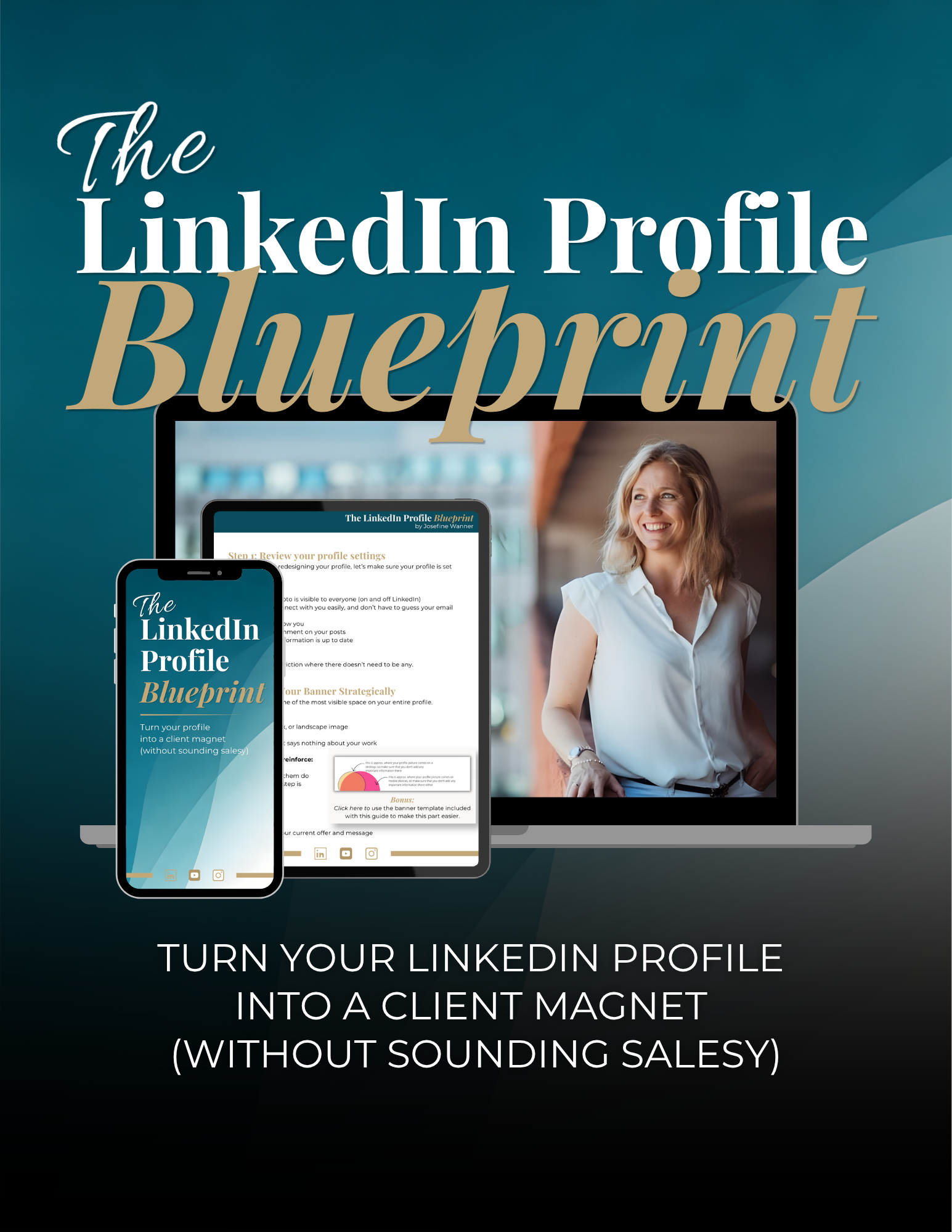
Get the LinkedIn Profile Blueprint here: https://www.josefinewanner.com/profile
And if you'd rather watch, I also have a YouTube video covering How To Update Your LinkedIn Profile - Step-by-Step. You can watch it on YouTube here:
Ready to build a business that gives you more options - not less?
There’s no single right way to build a freedom-based business.
And depending on where you are right now, your next step might look very different from someone else’s.
That’s why I’ve created a few different ways to take your next step, or work with me - whether you’re figuring out what comes next, ready to grow, or looking for more hands-on support.
Take a look, see what feels right, and pick your path.